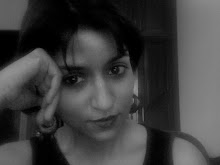
(Published in the Business Standard, April 2012. Rich was the first poet I read who gave me a blueprint for how to live, allowing me--and so many other women--to imagine what our lives could be, if we were willing to take them out of their steel dabbas and Tupperware containers.)
“Adrienne Cecil Rich,” wrote Sylvia Plath in her journal. “Little, round and dumpy, all vibrant short black hair, great sparkling black eyes and a tulip-red umbrella; honest, pink, forthright and even opinionated.”
The description was typical of Plath’s cattiness, expressed towards the women poets she feared most and saw as rivals, from Marianne Moore to Rich. But Plath was also perceptive: honest, forthright and opinionated could stand beside any of the epitaphs written this week for Rich, whose poetry and feminism turned the key in the lock for several generations of women, especially in the US.
Rich died at the age of 82; in 2011, she had published Tonight No Poetry Will Serve, her 25th collection of poetry. “I believe almost everything I know, have come to understand, is somewhere in this book," she wrote.
The path she chose was sharply divergent from the one taken by Plath and Anne Sexton—there were no gas ovens for Rich, and there would be no dark call to suicide, despite the personal tragedies she survived. Speaking at Sexton’s funeral, Rich said, “We have enough suicidal women poets, enough suicidal women, enough of self-destructiveness… I think of Anne Sexton as a sister whose work tells us what we have to fight in ourselves and the images patriarchy has held up to us. Her poetry is a guide to the ruins…”
Rich’s poetry was a guide to everything else—patriarchy and feminism, yes, but also love, also the Iliad, also the Vietnam war, also racism, also mermaids and divers. As she wrote in The Blue Ghazals, there were few frontiers between the personal and the political: “The moment when a feeling enters the body/ is political. This touch is political.” In her own life, Rich had gone from a conventional heterosexual marriage to a late discovery of her lesbianism; the shift from one to another was as important as the ripening of her radical politics.
Always, she came back to language: “That old, material utensil… found all about you, blank with familiarity, smeared with daily use.” Her task, and the work of poets, was to “make it into something that means more than it says”. Rich inveighed against the peculiarly 21st century disavowal of poetry, the tendency in the US and elsewhere to treat poets and poetry as marginal figures.
Art could help you save your life, when it was not “mistrusted, adored, pietized, condemned, dismissed as entertainment, auctioned at Sotheby’s, purchased by investment-seeking celebrities”. The true purpose of language was regenerative, even transformative, and that is what we lost when we relegated poetry and poets to the back shelves. Editing a poetry anthology, this is what she wanted: “Poems good enough to eat, to crunch between the teeth, to feel their juices bursting under the tongue, unmicrowavable poems.”
The power of Rich’s own poetry, from the time of her very first collection, A Change in The World, onwards was that they could be read by those who had followed her own radicalism, or by those who had chosen different paths—housewives in India, for instance. Feminist poetry is sometimes boxed too carefully, the life of the poet creating a kind of shrine around the work that kills off the poems themselves. It is hard to read Rich if all that you know about her is that she was a lesbian poet who fought the patriarchy, to quote one recent oversimplification.
Instead, read her poetry as a partial answer to a comment Gloria Steinem made recently: the task before present-day feminists, said Steinem, was to imagine what true equality would look like. Rich defined her own politics with elemental simplicity: she wanted, she said, “the creation of a society without domination”. By this, she meant domination of any kind—any one gender, class, race over another.
Of all the awards she received, the one that stands out in public memory was the 1973 National Book Award, where she refused to go on stage alone. Instead, Rich went onstage with Audre Lorde and Alice Walker, accepting her award in the name of all women. Over twenty years later, she would refuse the National Medal of the Arts, traditionally awarded to recipients at the White House, turning it down because of the cynical politics of the Clinton administration.
Perhaps what most will remember and cherish of Rich’s work are the explicitly political works—Diving Into The Wreck, for instance. But all of her writing was also a reminder to celebrate the human condition. This is what she wrote in Twenty-One Love Poems: “At twenty, yes: we thought we'd live forever./ At forty-five, I want to know even our limits./ I touch you knowing we weren't born tomorrow, /and somehow, each of us will help the other live,/ and somewhere, each of us must help the other die."
Showing posts with label poetry. Show all posts
Showing posts with label poetry. Show all posts
Tuesday, April 10, 2012


Wednesday, June 22, 2011
Speaking Volumes: A quartet of poets

(Published in the Business Standard, June 20, 2011; one of the last mainstream papers left in India where you can send in an 800-word column on poetry and not be told to go write about Chetan Bhagat.)
No one could claim that poetry is dead in India; the closest we can come is the lament of the (English language) publisher who says that poetry doesn’t sell. We still think in rhyme and stanza, from the advertising jingles on TV to the slogans painted by the Border Roads Organisation on twisting mountain paths to the ancient mantra on trucks: “Bure nazar waala, tera muh kala.” This is what Arvind Krishna Mehrotra, poet, critic, a living, walking library, calls “a listenership”.
The “listenership” for Kabir and Lal Ded has stayed constant over the centuries; the words of these mystics of the 15th and 13th centuries have been internalised to the point where their dohas and vakhs form part of our subconscious grammar. To have fresh and definitive translations of two of the great mystics, by two of India’s most linguistically acute poets, is a major literary event. Ranjit Hoskote’s translation, I, Lalla: The Poems of Lal Ded (Penguin Classics) came out within a month of the release of Arvind Krishna Mehrotra’s Songs of Kabir (NYRB/ Hachette India).
Both mystics left behind patchwork biographies; in their times, as in ours, chronicling the lives of saints and of poets came a distant second to chronicling the lives of rulers and warriors. But Mr Mehrotra and Mr Hoskote have a similar understanding of what is important, and what is unessential: “An authentic Kabir poem, in the thousands attributed to him, may never be found, nor does it matter,” Mr Mehrotra writes in his introduction. “If you catch the spirit, anyone can write an authentic Kabir poem. Innumerable anonymous poets have done so in the past and continue to do so even today, adding their voices to his.”
And Mr Hoskote, acknowledging the many gaps in the popular rendering of the life of Lalla, explains: “Lalla, to me, is not the person who composed these vakhs; rather, she is the person who emerges from these vakhs.”

These books stand testimony to the argument that only poets should translate poets. Mr Mehrotra, translating Kabir’s Chewing Slowly, begins with an epigraph from the late poet Arun Kolatkar. Chewing Slowly describes how the seeker finally finds the beloved, only after cutting the cord with family, in-laws and the town’s inhabitants. The epigraph Mr Mehrotra chooses is from Kolatkar’s translation of the 14th century Marathi poet Janabai: “god my darling/ do me a favour and kill my mother-in-law.” There they are, speaking to each other across the ages; two translators who are also poets, placing in conversation with each other two poets who are also mystics. Mr Mehrotra’s translations are superb, true to the ear, true to the line; soaring with Kabir’s own images and Mr Mehrotra’s occasional contemporarisations. “Kabir knows everything,” he writes, “including a Jamaican sect and the name of a London publishing house.”
If you pressed either poet, Mr Mehrotra or Mr Hoskote, they might not be able to tell you with exactitude when one starts a translation. Mr Mehrotra’s translations of Kabir may have begun, technically, just a few years ago; but as he references Cavafy and Kolatkar and Rasta poets, what comes through in these precise, richly shaped lines is a lifetime’s understanding of poetry. Mr Hoskote writes, “I began this translation of Lal Ded’s poems in February 1991, a month short of twenty-two; I am nearly forty-two as I come to the end of the process.”
Living with Lalla’s words for years and decades shaped him; he had begun to translate her vakhs because she provided a connection to his own Kashmiri past, a lost heritage. But as he continued, he moved slowly to an engagement with faith, his life as a poet following the arc of the poet he was trying to translate and understand: the very different experience of “a religious seeker, a social rebel, a woman”. “The translator is always humbled, broken and remade in the act of translation.”
There is no room to write about the meaning of their lives and work, the four poets who are inexorably twinned twice over in these two books. And perhaps this column is not the right place in which to explore the kind of faith – so sharply opposed to the unassailable, mean-spirited dogma that passes often as faith these days – that Kabir and Lalla had to offer. That exploration should be done by one better versed in religious studies and in poetry than this columnist.
But these two mystics shared a similar path, a similar way of thinking. This verse, written by Lalla, could have been spoken by Kabir: “First the washerman pounded me on his washing stone,/ scrubbed me with clay and soap./ Then the tailor measured me, piece by piece/ with his scissors. Only then could I, Lalla, find the road to heaven.”
To read these translations is to rediscover what you already know and love, but also to have the well-known, cherished dohas and vakhs of Kabir and Lalla made new. Both Mr Hoskote and Mr Mehrotra ask an uncomfortable but thought-provoking question: what kind of reception would a Kabir or a Lalla be given today?
Would they be ignored, would they be invited to the literary festivals of the hour, would their words invite bans for offending religious sentiments, or would they, perhaps, still have an audience? I don’t have answers, but it’s an interesting questi
Subscribe to:
Posts (Atom)